
Copper vs aluminium wire is a choice that shapes cost, cable size, connection safety and how long an installation lasts. Copper carries more current in a smaller conductor and has a long record in building wiring. Aluminium weighs far less and usually costs less per kilogram, but it needs a larger cross-section and more care at every terminal. This guide compares the two metals on conductivity, cost, connection safety and performance, then explains where each one fits. Bonex Cables wrote it for OEM buyers and engineers who need a clear basis for choosing between copper wire and aluminium wire.
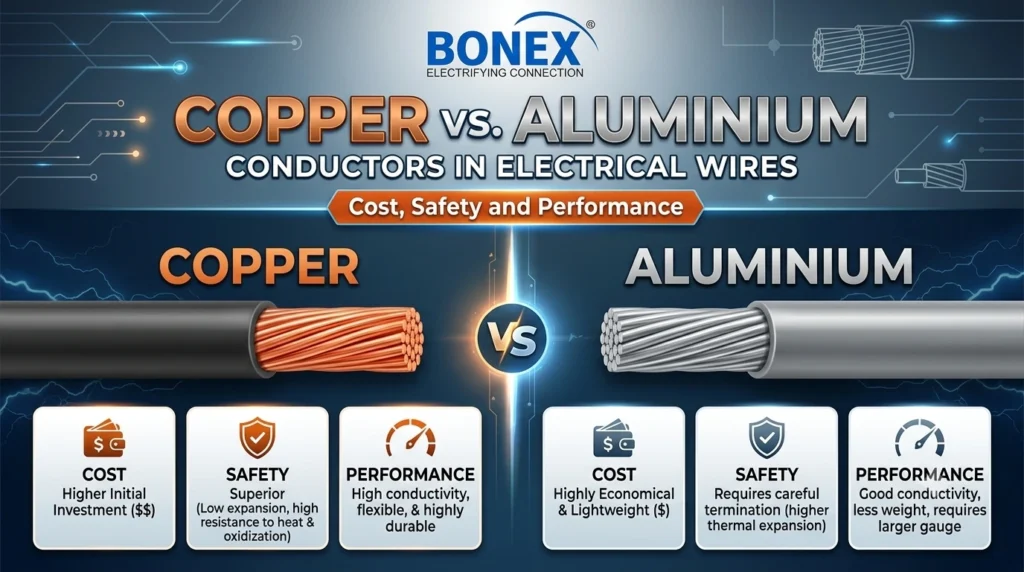
Copper vs Aluminium Wire: Conductivity and Cross-Section
Conductivity sets the baseline copper vs aluminium wire. Copper is the reference at 100% IACS, the International Annealed Copper Standard, and aluminium reaches roughly 61% to 62% of that figure (ServiceWire, RCET study). Lower conductivity means higher resistance, and Electracables estimates aluminium’s resistivity at about 1.68 times copper’s.
To carry the same current, an aluminium conductor has to be physically larger. Estimates differ slightly. Nexans and Brainbound both put the requirement near 1.6 times the copper cross-section, while Electracables cites about 56% more area. Whichever figure you use, the aluminium conductor is visibly thicker, and that extra size carries into conduit and tray sizing.
Ampacity, the continuous current a conductor can carry, follows the same pattern. At an identical cross-section, Electracables puts copper’s current-carrying capacity roughly 30% to 50% above aluminium’s. The extra resistance in aluminium turns into heat, and heat is what sets the limit. Never swap metals at the same nominal size. Re-check the ampacity table for the metal you are actually buying.
Copper vs Aluminium Wire Cost and Copper Wire Price
Aluminium usually has the lower purchase price, which is why it still appears on large projects. Metal prices move daily, so date every figure you use. MetalsPlace listed LME copper cathode at about USD 11,515 per tonne on 19 November 2026, after a drop of nearly 3% over the day. For aluminium, Kalkine reported LME three-month aluminium at about USD 3,064 per tonne on 6 November 2026. The two figures come from different dates, so treat them as a snapshot, not a quote.
The metal price is only one line in the budget. DMA Engineers compared 95 mm² copper with 120 mm² aluminium and found the price gap small next to hidden costs such as larger conduit. Nexans reports that a life-cycle cost analysis finds the lifetime cost difference negligible.
Copper wire price in India is harder to pin down. One supplier page lists copper wire at ₹780 to ₹850 per kg, yet the same page shows a branded product at ₹1,229 to ₹1,249 per kg (OfBusiness). Grade, size, insulation and brand all move the figure. Bonex Cables recommends asking for a dated quote against your exact specification.
Copper vs Aluminium Wire Safety at Connections and Standards
Most aluminium problems start at the connection, not along the conductor. Aluminium oxidises more easily than copper, and the resulting oxide raises resistance at a joint (Electracables). Expansion adds to the problem, since Inspectapedia notes that expansion can overheat connections between wire and devices. The older AA-1350 alloy also showed significant creep under repeated heating, and creep at a connection is a serious problem (Hackaday).
The fire record explains why the topic is so sensitive. The US Consumer Product Safety Commission reported in 2011 that homes built before 1972 and wired with aluminium were 55 times more likely than copper-wired homes to have one or more outlet connections reach fire hazard conditions (CPSC). That figure covers outlet connections in older wiring. The report developed no figure for aluminium-wired homes built after 1972.
Newer alloys changed the picture. The AA-8000 series was developed to reduce creep, and one industry account says its creep rates are very similar to copper building wire (Facility Executive). US code allows solid AA-8000 wire on 15 A and 20 A branch circuits when the terminations are rated for aluminium (Wikipedia).
In India, the BIS standard IS 694 covers unarmoured PVC insulated cables with copper or aluminium conductors, but its flexible cord provisions apply to copper conductors (BIS). Check the certification scope on each product. Whichever metal you choose, match every terminal to the conductor metal, use rated devices, and tighten connections to the maker’s torque value. Bonex Cables advises buyers to treat the connection as the most important part of the design.
Copper vs Aluminium Wire Performance at a Glance
| Property | Copper | Aluminium |
| Conductivity (IACS) | 100% | About 61% to 62% |
| Density | 8.96 g/cm³ | 2.70 g/cm³ |
| Cross-section for the same current | 1.0 | About 1.6 times |
| Current at the same cross-section | About 30% to 50% higher | Lower |
| Weight for the same conductance | 1.0 | About 0.5 |
| Joints and terminations | Resists oxidation | Oxidises; needs rated terminations |
| Typical use | Most low-voltage final circuits and flexible cords | Overhead lines where weight matters |
The ratios above are rounded. Area estimates range from about 1.56 to 1.6 across the sources cited earlier.
Copper vs Aluminium Wire: Where Each Metal Fits
Copper wire fits best where many terminations, tight spaces and movement come together. DMA Engineers describes copper as the main choice for low-voltage work, with overhead installations as the usual exception where weight is a deciding factor. Nexans adds that copper’s higher fatigue limit extends its life span (Nexans).
Aluminium wire fits best in overhead spans and heavy runs, where lower weight and material cost outweigh the need for a smaller conductor. Its lighter weight also eases the load on poles and supports. Because aluminium is softer than copper, it is easier to damage through repeated bending, so it suits fixed installations better than moving parts (Polycab).
For OEM harnesses, appliance leads and anything that flexes, Bonex Cables recommends copper. Choose aluminium only after the size, terminations and standard coverage have been checked.
Conclusion: Copper vs Aluminium Wire for Your Project
Price alone rarely settles the question copper vs aluminium wire. Copper gives a smaller conductor, higher current at a given size and more forgiving terminations. Aluminium gives a lighter, usually cheaper conductor, but it needs a larger size, rated hardware and disciplined installation. For indoor and flexible applications, copper is the safer default. Aluminium makes sense for overhead and heavy feeder runs when the design accounts for size and connections. Before you commit, check the current LME price, get a dated supplier quote, confirm the standard covers your chosen metal, and ask for test records on the connections.
Copper vs Aluminium Wire FAQs
Is Copper vs Aluminium Wire Cheaper to Buy?
Usually, yes. Aluminium’s lower metal price is the main reason buyers choose it. The saving narrows once you add larger conduit, bigger trays and rated hardware, so compare the installed cost rather than the price per kilogram.
Does Copper vs Aluminium Wire Change the Cable Size?
Yes. For the same current, aluminium generally needs about 1.6 times the cross-section of copper, although some sources put the figure closer to 1.56. Always size from the ampacity table for the metal you are buying.
Is Copper vs Aluminium Wire Safe for Home Circuits?
Both can be safe when they are designed and terminated correctly. The strongest evidence of risk involves older aluminium branch wiring at outlets, where the CPSC found a much higher rate of fire-hazard conditions. Modern AA-8000 wire is treated differently, but it still needs rated devices.
Should the Copper Wire Price Decide Copper vs Aluminium Wire?
Not on its own. Copper’s price follows the LME and varies with grade, and listed rates in India differ widely. Use price as one input, alongside size, weight, terminations and standard coverage.