
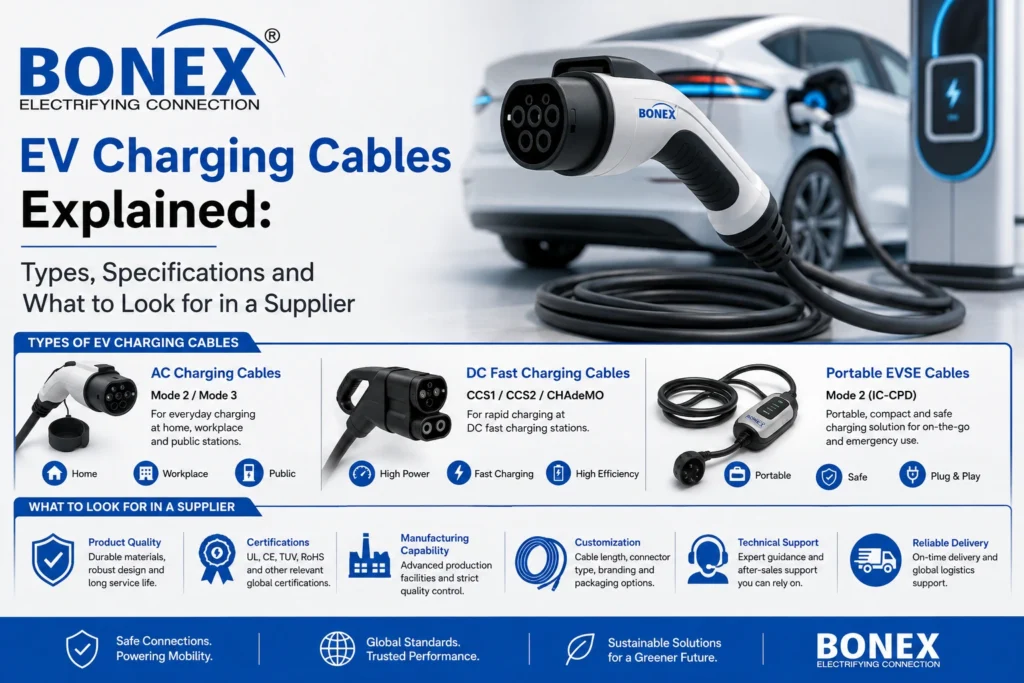
An EV charging cable carries power from the charging point to the car, so its connector, current rating and build quality all affect safety and daily use. The right choice depends on your car’s inlet, your charging point and the phase supply at home or on site. This guide covers the main types and specifications and what to check in a supplier. Bonex Cables recommends starting with the vehicle inlet before you compare ratings.
Why Your EV Charging Cable Choice Matters
A cable that fits the car but not the charging point leaves you stuck, and a cable rated below the charger’s output can overheat. An EV charging cable also faces rain, dust, frost and repeated plugging, so build quality matters as much as the connector. Bonex Cables suggests checking connector, current, phase and environmental ratings together, since one mismatch can undo the rest.
Charging Modes: Mode 2 and Mode 3 Explained
All About Circuits describes the four charging modes in IEC 61851. Mode 1 plugs the car straight into a household socket at up to 16 A, with no communication. Mode 2 uses a Mode 2 EV charging cable with an in-cable control and protection device (IC-CPD), and it works from household or industrial sockets up to 32 A. Mode 3 relies on a dedicated charging station alongside the car’s onboard charger.
The IC-CPD requirements sit in IEC 62752. The current edition is the 2024 second edition, which replaces the 2016 edition with its 2018 amendment and adds a mandatory temperature control device for household plug contacts.
Mode 2 suits portable, occasional charging. A fixed home installation is usually built around Mode 3, and Top Cable describes Mode 3 as AC charging with control and communication via the cable.
Type 2 EV Cable vs Type 1: Which Connector Do You Need?
A Type 2 EV cable and a Type 1 cable differ in pins and power. In a seller’s comparison, Type 1 has five pins, supports single phase only and tops out at 7.4 kW. Type 2 has seven pins, supports single and three phase, and reaches 22 kW where the car accepts it. Type 2 is the standard in the UK and across Europe, while Type 1 is the common connector in North America.
Start with the car, since its inlet sets which cable you need. The same comparison suggests opening the inlet flap and counting the pins before you order.
Key Specifications: Power, Current, IP Rating and Jacket
Power follows voltage, current and phase. A cable seller’s guide gives the formula as kW equals volts times amps, divided by 1,000, and the figures below follow from it.
| Supply | 16 A | 32 A |
| 1-phase (230 V) | 3.7 kW | 7.4 kW |
| 3-phase (400 V) | 11 kW | 22 kW |
The vehicle’s own charger sets the ceiling, so a three-phase EV charging cable pays off only if the car accepts more than 7.4 kW.
IP ratings follow IEC 60529. IP65 covers protection against water jets, IP66 against powerful jets, and IP67 against temporary immersion up to one metre for 30 minutes. A cable seller calls IP67 the gold standard for outdoor cables.
Jacket material matters in cold weather. One TPE supplier’s comparison reports TPE with no cracking at -40°C, while PVC hardens at -15°C. Treat that as the supplier’s own data, and ask for independent cold-bend results.
DC and Regional Connectors: CCS2, CHAdeMO and GB/T
Fast DC charging uses different connectors. A standard AC cable has no DC pins, and in Mode 4 the cable stays permanently attached to the charging station, according to All About Circuits. Battery Design lists the main DC standards with their ceilings:
| Connector | Region | Max current | Approx. power |
| CCS1 | North America (legacy) | 500 A | ~350 kW |
| CCS2 | Europe and rest of world | 500 A | ~350 kW |
| CHAdeMO | Japan | 400 A | ~400 kW |
| GB/T 20234.3 | China | 800 A | ~1,200 kW |
The same source says these are standard ceilings, not typical deployed power. Buy a DC cable only if your fleet or site uses DC charging, because an AC EV charging cable cannot stand in for one.
What to Look for in an EV Charging Cable Supplier
Supplier paperwork shows whether an EV charging cable was built and tested for the job. Use this checklist when you compare quotes.
Certifications for the EV Charging Cable
- Connector standard: IEC 62196 for Type 2 connectors. One supplier says its cables comply with IEC 62196 and EN 50620, alongside CE marking.
- Mode 2 safety: IEC 62752 for any in-cable control and protection device, as Battery Design summarises it.
- Ingress protection: IEC 60529 ratings, stated for both the cable and the connector.
- Substance compliance: RoHS and REACH documentation for EU sales.
Testing, Traceability and Warranty
Ask for batch test reports tied to lot or serial numbers, cold-bend results for the jacket, and warranty terms that name what is covered. Bonex Cables suggests requesting documented test results for each connector and jacket before you place an order, because headline ratings alone do not show how a cable performs in your weather.
Conclusion: Matching the EV Charging Cable to Your Car and Site
Work through the choice in order EV charging cable: confirm the car’s inlet, match the phase and current to your charging point, then check the IP rating and jacket for where the cable will live. Verify the standards and test reports before you buy. Bonex Cables recommends buying from a supplier that can show compliance evidence for every connector and jacket, not just the headline rating.
Frequently Asked Questions
Is an EV Charger Cable the Same as an EV Charging Cable?
Usually yes. Both terms describe the cable between the charging point or socket and the car. Judge any EV charging cable by its connector, current and rating rather than the name on the packaging.
Can a Type 1 Car Use a Type 2 Charger?
Not directly. You need a cable with the car’s connector at one end and the charger’s connector at the other. Check the inlet first, because it decides which cable you need.
What Power Does a 32 A Type 2 EV Cable Deliver?
Up to 7.4 kW on single phase and 22 kW on three phase, if the car and charging point support them. The vehicle’s onboard charger sets the real ceiling, according to Voldt.
What IP Rating Does an Outdoor EV Charging Cable Need?
IP67 is the rating that cable sellers call the gold standard for outdoor use, and it covers temporary immersion. IP65 and IP66 cover water jets. Confirm that the rating applies to the connector as well as the cable.