
Cable testing is the check that stops a small defect in a cable from becoming a fire in a building, a machine or a product a customer has already bought. A cable rarely fails all at once. A loose termination heats up, insulation cracks or a conductor is undersized, and the damage grows until the cable arcs or overheats. Recent CPSC recalls of power strips and appliance cords follow the same pattern. This guide explains how those failures start, which standards and tests catch them, and how flame-retardant coating and clear test records keep a product out of a recall. Bonex Cables wrote it for OEM buyers and product teams who need to know what to ask for before a cable leaves the factory.
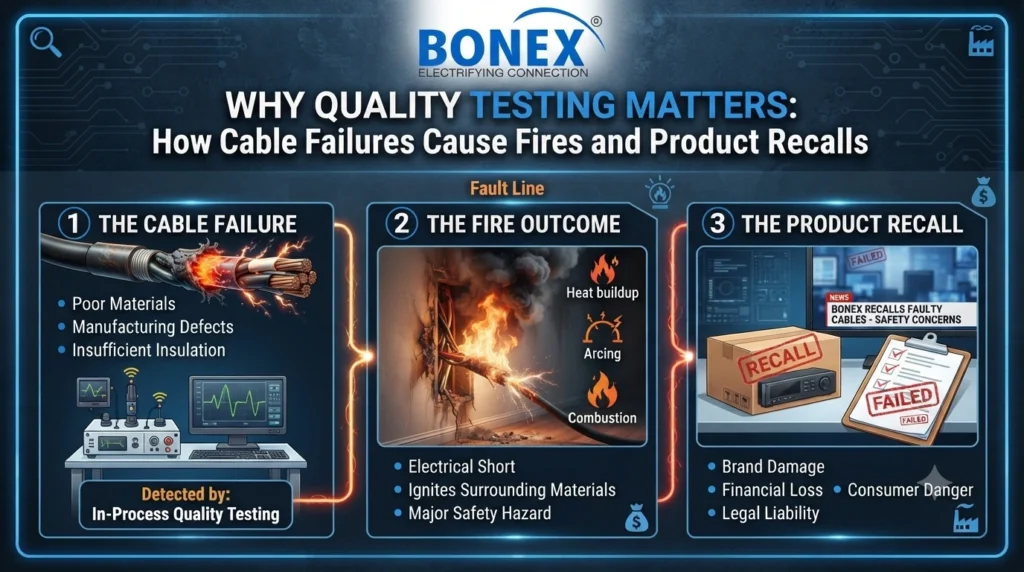
Cable Testing: What Causes Cable Failures
Most cable fires need heat, and most of that heat comes from three faults. One engineering review of electrical overheating names excessive current, poor connections and insulation breakdown as the main modes that lead to fire (ECM). Poor connections deserve particular attention because they can concentrate high power in a small area for a long time.
Connections loosen and corrode. Fluke lists loosening, corrosion and rising resistance as the root cause of poor connections. The BSEE safety alert makes the same point: a faulty connection can produce substantial heat without much impeding current flow.
Insulation and conductors fail in other ways. Charred insulation can become conductive and start arc tracking, which produces intense local heat (Fluke). A study of residential electrical fires lists broken wires with intermittent contact and damaged cord sets among the failure modes. Undersized wire is another root cause that appears in the same review.
Each fault has a matching test. Thermal imaging finds hot joints, resistance checks find loose or corroded terminations, and insulation resistance testing finds damaged insulation. Bonex Cables advises buyers to check the termination and the conductor size together, because a correctly sized conductor can still fail at a loose joint.
Cable Testing Standards: What IS 694 Requires
In India, IS 694 is the BIS standard for PVC insulated power and lighting cables. It covers unarmoured cables with copper or aluminium conductors, and flexible cords with copper conductors, for AC systems up to 1100 V.
The standard divides its tests into two groups. Routine tests run on every finished length. For IS 694 these include a conductor resistance test and a high voltage test, and the spark test can replace the high voltage test on single-core unsheathed cables (IS 694 text). Type tests qualify a cable design before production and cover conductor checks, insulation and sheath thickness, and flammability.
The category changes the test list. Category 01 is for indoor use and 02 for outdoor use. The FR category adds an oxygen index of at least 29% and a temperature index of at least 21% at 250°C. FR-LSH adds those tests plus a limit of 20% by weight on halogen acid gas and a smoke density rating (IS 694 text).
A certificate alone does not tell you what was tested. Bonex Cables recommends asking for the type test report for the exact category and conductor you are buying.
Cable Testing Methods: How Electrical Wire Testing Finds Defects
Electrical wire testing answers different questions, so each method suits a different defect. Three high-voltage tests are common. Dielectric breakdown raises the voltage until the insulation fails, which destroys the sample, so it serves mainly for design and qualification. Dielectric withstand, or hipot, applies a fixed voltage for a fixed time and checks for current flow, which makes it a pass-or-fail test. Insulation resistance applies a voltage and derives resistance from the current that flows (Cirris).
Hipot is the most direct check for physical damage. It picks up nicked or crushed insulation, stray strands and conductive contamination (Cirris). For multicore cables and cords, IS 694 sets the high voltage test at 3 kV rms AC or 7.2 kV DC for five minutes (IS 694 text).
Conductor resistance is the simpler check. It measures how easily current moves through the metal, which helps confirm that a conductor matches its specified size and material. Insulation resistance is highly sensitive to contamination such as flux, oils and moisture (Cirris).
Once cables are installed, the same logic moves to thermal imaging and resistance checks at terminations. Fluke lists poor connections as a root cause of overheating, so terminations are the first place to test.
Cable Testing for Cable Fire Retardant Coating Performance
A cable fire retardant coating is judged by the flame test it passes, not by the datasheet claim. A flame-retardant cable is designed to limit ignition and flame spread under a specified test, and it may self-extinguish once the flame source is removed (L-com).
The single-cable test is the first hurdle. IEC 60332-1-2 applies a 1 kW pre-mixed flame to one vertical insulated wire or cable (Tratos). Bunched cables face a harder test, because fire can spread along a bundle. The IEC 60332-3 series sets categories by the combustible material per metre of sample, from 7 litres for Category A down to 0.5 litres for Category D (Tratos).
Under IS 694, the FR category adds an oxygen index test with a minimum of 29% and a temperature index test with a minimum of 21% at 250°C. FR-LSH adds limits on halogen acid gas and smoke (IS 694 text).
A flame-retardant rating does not guarantee low smoke, low halogen content or continued operation during a fire, and it applies only to the test it passed (L-com). Bonex Cables recommends matching the coating to the standard your installation and local code require, and asking for the flame test report for that exact standard.
Cable Testing Gaps That Lead to Product Recalls
A recall is what happens when a cable fault passes testing and reaches the customer. Two 2026 CPSC recalls show the pattern. In March, CPSC recalled about 5,543 CCCEI-branded power strips with 6, 10 and 15 foot cords. The strips lacked supplementary overcurrent protection, so an overloaded strip could catch fire (CPSC). They had been sold on Amazon for nearly two years, from April 2024 to January 2026, before the recall. Two reports of sparking and melting had come in, and the page lists no fires or injuries.
In July, Panasonic recalled about 11,480 toaster ovens in the U.S. The power cord insulation can be insufficient because a protective fiberglass sleeve does not cover it adequately, which creates a shock or fire risk (CPSC). That is a cable-level gap inside an appliance, the kind a test plan should catch before shipment.
Seen as a fire risk, an electrical cable explained simply is a heat source sitting next to fuel. The electrical system supplies the heat, and nearby material usually supplies the fuel (Fluke). When testing does not rule out a fault before shipment, that fault can end up in a recall.
Conclusion: Cable Testing as the Control That Prevents Fires and Recalls
Cable failures usually start at a connection, an insulation fault or an undersized conductor, and they become fires when heat meets fuel. Cable testing breaks that chain at three points: routine tests on every length, type tests on each design and category, and flame tests that match the installation. The records matter as much as the tests, because a recall is far harder to contain when the paperwork cannot show what was tested. Before you release a cable or an appliance, confirm the standard and category, ask for the test report, and check the terminations as well as the conductor. Bonex Cables recommends building that checklist into every purchase order, not only the first sample.
Cable Testing FAQs
What Is Cable Testing for Electrical Wire?
It is the set of checks that confirms a cable meets its standard before it ships. Under IS 694, routine tests run on every finished length, including a conductor resistance test and a high voltage test, while type tests qualify the design (IS 694 text).
Which Cable Testing Methods Find Insulation Damage?
Hipot testing is the most direct check. It finds nicked or crushed insulation, stray strands and conductive contamination, while insulation resistance testing is highly sensitive to moisture and flux (Cirris).
Does Cable Testing Cover Cable Fire Retardant Coating?
Yes, but only for the flame test a cable actually passed. IEC 60332-1-2 tests a single vertical cable with a 1 kW flame, the IEC 60332-3 series tests bundles, and IS 694 adds FR and FR-LSH categories (Tratos). A flame-retardant rating does not prove low smoke or continued operation in a fire (L-com).
How Can Cable Testing Prevent a Product Recall?
Testing before shipment is the main barrier, and the test record is what proves it. The CCCEI power strips recall involved missing overcurrent protection, a design gap that a test plan should review before production (CPSC).