
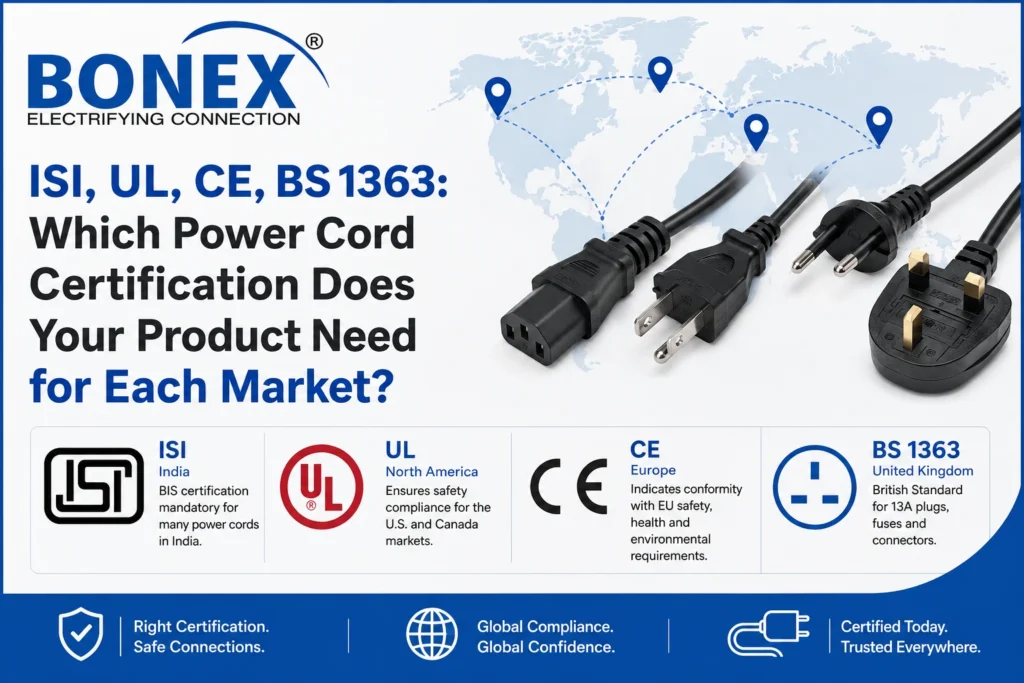
Power cord certification is market-specific. A cord that is legal in one country can be unsellable in the next, so the right mark depends on where your product will be sold. India uses the ISI mark, North America relies on UL listing, the European Union uses CE marking, and the UK requires BS 1363 plugs. This guide explains what each mark covers and how to match them to your markets. Bonex Cables suggests mapping certification by market before you lock in a cord design.
Why Power Cord Certification Matters Before You Sell
Power cord certification affects customs clearance, retailer listings and the liability you carry if a cord fails. Each market names its own mark, standard and plug, so a cord approved in one country may not clear another. Bonex Cables recommends mapping target markets before you finalize a cord design, because changing a plug or conductor late means retesting.
ISI Mark: Power Cord Certification for India
The ISI mark scheme is run by BIS, and India Briefing says the mark is mandatory for over 450 products and voluntary for about 900. Plugs are the clearest case. A BIS quality control order covers plugs rated up to 250 V and 16 A, requires conformity with IS 1293:2019 and calls for an ISI mark under a BIS licence. It took effect in October 2023 and excludes goods made for export (Elitas RCS).
Cords are less settled. The 2026 electrical appliance QCO guide, effective 1 October 2026, does not name power cords or cord sets. A cord extension set standard, IS 18830, remained voluntary in a guide updated in March 2026. Check the official BIS text before you rely on either.
UL Listing: Power Cord Certification for the United States
UL 817, Cord Sets and Power-Supply Cords, covers cord sets with molded-on or assembled-on fittings. It applies up to 600 V and to non-hazardous locations under the US National Electrical Code. A UL listed power cord carries a listing for the product that was tested, so ask for the listing itself rather than a general claim. Ratings can also differ by listing. A C20 receptacle is rated 20 A under UL and 16 A under IEC, both at 250 V AC.
CE Marking: Power Cord Certification for the European Union
The Low Voltage Directive 2014/35/EU is the starting point for cords. It covers cords in the 50 to 1,000 V AC range, even when they are sold separately from the equipment. Packaging decides whether a cord needs its own mark. A cord shipped with an appliance and used only with it need not carry a separate CE mark, but a cord sold alone does (Interpower). For compliance routes, the CE Marking Association names EN 50525 or IEC 60227 for cords and BS 1363 or IEC 60884 for plugs, backed by certificates from a notified body.
BS 1363: Power Cord Certification for the United Kingdom
The UK plug system is built on BS 1363. BSI notes that UK law ties appliance plugs and installation outlets to this series, and BS 1363-1 covers 13 A fused plugs. Approval is the key step. BSI states that all BS 1363 plugs sold in the UK must be approved by a notified body, such as BSI through the Kitemark, and that ISO 9001 pre-certification is often required for those schemes. The 2016+A1:2018 edition of BS 1363-1 is listed as withdrawn from 30 June 2026, so confirm which edition your certifier tests to.
IEC Power Cord Types Chart: Connectors, Ratings and Uses
The connector shapes behind most IEC power cord types come from IEC 60320, which fixes their orientation and maximum ratings. NetApp notes that the common types it lists are all rated 250 V AC. The chart below covers the most common pairs, using ratings from Access Communications.
| Pair | Nickname and typical use | Max current | Max temperature |
| C5/C6 | “Mickey Mouse” cloverleaf; laptop adapters, projectors | 2.5 A | 70°C |
| C7/C8 | “Figure-8”; laptop adapters, radios, gaming consoles | 2.5 A | 70°C |
| C13/C14 | “Kettle cord”; desktops, monitors, servers, switches | 10 A | 70°C |
| C15/C16 | “Hot condition”; kettles and devices near heat sources | 10 A | 120°C |
| C19/C20 | “High-current”; servers, blade chassis, rack PDUs | 16 A | 70°C |
Odd numbers are the female cord connectors and even numbers are the male equipment inlets, so a C13 cord fits a C14 inlet. Connector ratings are ceilings: the power supply, PDU and site wiring can all set a lower limit, so check the equipment label first. Bonex Cables recommends matching the connector pair, current and temperature to that label before you order.
Which Certification Each Market Needs
Power cord certification rules differ by market, so map each target country to its mark before you finalize a design.
| Market | Mark or approval | Governing standard or body | Key point |
| India | ISI mark | BIS; IS 1293 for plugs | Mandatory for plugs; check cord status |
| United States | UL listing | UL 817 | Listing covers the tested product |
| European Union | CE marking | Low Voltage Directive 2014/35/EU | Cords sold alone need their own mark |
| United Kingdom | BS 1363 approval | BS 1363 series; BSI Kitemark | All plugs sold in the UK need approval |
Use this four-step check before you ship:
- List every target country and whether the cord ships with the product or alone.
- Match each country to the mark in the table.
- Confirm plug, connector and current ratings against the equipment label.
- Ask your certifier to confirm the current standard edition, since older BS 1363-1 editions are withdrawn.
Conclusion: Mapping Power Cord Certification to Your Markets
The destination market, more than the product itself, determines power cord certification. Start with your target countries, then match each one to its mark: ISI for India, UL listing for the United States, CE marking for the EU and BS 1363 approval for the UK. Rules change, so confirm cord and plug status with a certifier before each launch. Bonex Cables suggests planning certification during design, which keeps the number of cord variants you must certify as small as possible.
Frequently Asked Questions
Does ISI Power Cord Certification Apply to Plugs and Cords?
Plugs do. A BIS order requires an ISI mark under a BIS licence for plugs rated up to 250 V and 16 A. Cords are not clearly covered by the 2026 appliance order, so confirm their status with BIS before you sell in India.
What Does a UL Listed Power Cord Mean?
It means the product has been evaluated against a UL standard, such as UL 817, and listed for the product that was tested. Ask for the listing and check it, rather than accepting a general claim.
How Do I Read an IEC Power Cord Types Chart?
Start with the connector pair, then compare current and temperature with the equipment label. According to NetApp, a C13 cord mates with a C14 inlet, and a C19 cord mates with a C20 inlet.
Is Power Cord Certification Needed for Cords Sold With an Appliance?
Usually not on the cord itself. If the cord ships with an LVD-covered appliance and works only with it, the CE mark goes on the main product. A cord sold alone carries its own CE marking (Interpower).