
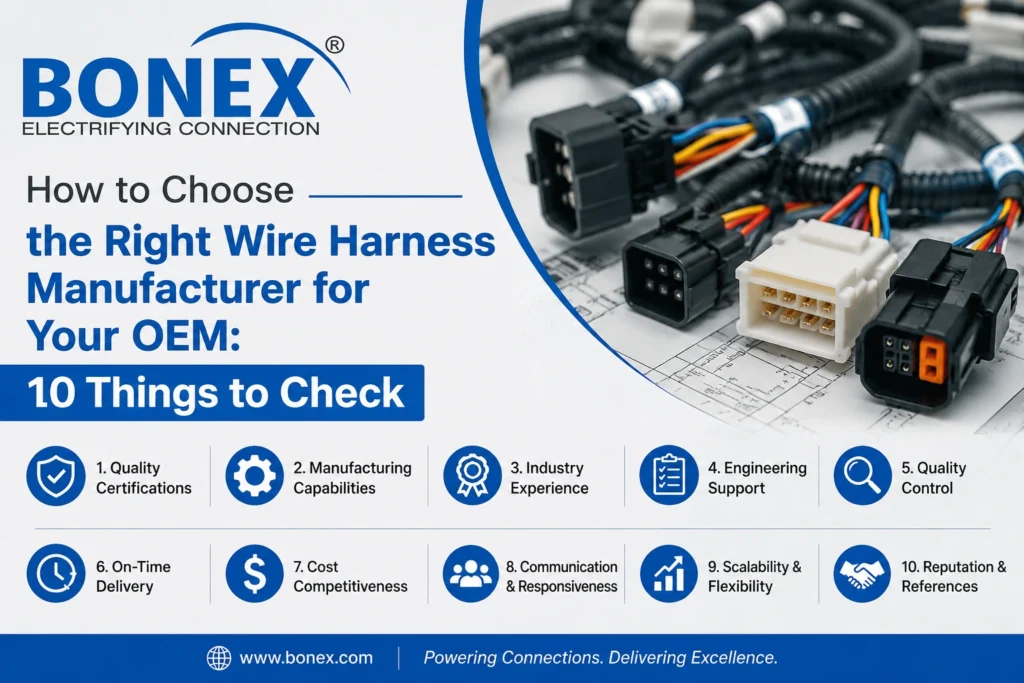
Choosing a wire harness manufacturer is one of the most consequential sourcing decisions an OEM makes. The harness carries power and signals through your product, so a weak supplier shows up later as field failures, warranty claims and line stoppages. If you are shortlisting partners, Bonex Cables recommends running the ten checks below on every candidate before you sign.
1. Confirm Industry Experience in Your Sector
A harness for a washing machine faces different demands from one built for an electric vehicle or a medical monitor. Ask each wire harness manufacturer for examples of similar projects, including voltage range, connector families and operating environment. A supplier who has shipped in your sector already knows the failure modes to design out, such as vibration, heat and moisture.
2. Verify Certifications and Quality Systems
Certifications show that a supplier runs repeatable processes rather than relying on individual skill. Look for ISO 9001 as a baseline, IATF 16949 for automotive programs and ISO 13485 for medical devices. Request current certificates, check expiry dates and confirm the scope covers the exact plant that will build your parts. Bonex Cables suggests rejecting any certificate that covers only a head office, since it says little about your line.
3. Assess Engineering Support From Your Wire Harness Manufacturer
Strong partners do more than follow drawings. They review your design for manufacturability, suggest more reliable connectors and support DFMEA and PFMEA reviews. Ask who owns design changes, how fast they turn a revision and whether they build prototypes before tooling is committed. Good engineering support is often the difference between a harness that assembles smoothly and one that slows the line.
4. Check Material Sourcing and Traceability
Wire gauge, insulation, terminals and connectors all affect performance, and a cost-driven substitution can change how the product behaves. Ask your wire harness manufacturer where copper and components come from, whether it maintains an approved vendor list and how it records lot numbers. Full traceability lets you isolate a bad batch in days rather than recalling every unit built that quarter. If your product is sold in the EU, confirm RoHS and REACH compliance in writing.
5. Evaluate Production Capacity and Scalability
A shop that handles a 500-piece prototype run may struggle at 50,000 units a month. Ask about assembly methods: assembly boards suit low to medium volumes, while rotary conveyors and automated processing suit high volumes. Request typical lead times from purchase order to shipment, and ask how the supplier would absorb a 30 percent jump in forecast demand.
6. Review Wire Harness Testing Capabilities
Strong wire harness testing separates a dependable supplier from a hopeful one. Ask whether each harness is checked 100 percent or sampled, and which tests run on every batch.
Core Wire Harness Testing Methods to Request
- Continuity testing confirms every conductor connects to the intended pin.
- High-potential (hi-pot) testing applies high voltage to confirm the insulation holds.
- Insulation resistance testing measures leakage between circuits.
- Pull-force testing confirms crimped terminals hold under load.
Bonex Cables recommends asking for test reports tied to each serial number, so you can trace any unit back to its results.
7. Consider Location and Logistics
Plant location affects freight cost, lead time and how easily your team can visit. If you are comparing wire harness manufacturers in India, weigh shipping time, export documentation and the supplier’s experience with international buyers. Shortlists that include wire harness manufacturers in Delhi NCR can make site visits and sample pickups easier to arrange, because the region hosts many industrial units. Whichever region you choose, ask for a plant tour in person or by video before you finalize the order.
8. Judge Communication and Project Management
Responsiveness during quoting usually predicts responsiveness during production. Look for a named project manager, drawings and documentation in your working language, and a clear escalation path. Ask how each wire harness manufacturer handles engineering change notices and how quickly it answers a quality question. A supplier that is slow to reply before the order rarely speeds up afterwards.
9. Compare Total Cost, Not Just Unit Price
The lowest quote can become the most expensive harness once rework, scrap, line downtime and warranty returns are added. Ask every supplier for a breakdown of material, labor, tooling, testing and packaging. Then compare total cost of ownership across a full product year. Bonex Cables encourages buyers to see past the quote: a slightly higher price from a supplier with stronger testing and traceability often costs less overall.
10. Review Warranty, Documentation and Change Control
Read warranty terms closely, including defect coverage, return freight and replacement turnaround. Confirm you will receive drawings, bills of materials, inspection reports and revision history. Strong change control means no design change happens without written approval from both parties. These records protect your product long after the first shipment.
Conclusion: Picking the Right Wire Harness Manufacturer
Selecting a supplier is an engineering and commercial decision, not a simple price comparison. Score each candidate against the ten checks, request samples and test reports, and visit the plant when you can. Bonex Cables encourages OEM teams to ask detailed questions before they commit. A well-chosen wire harness manufacturer becomes a long-term partner that protects your product’s reliability from the first prototype to the final unit.
Frequently Asked Questions
What Does a Wire Harness Manufacturer Do?
A wire harness manufacturer cuts, strips, crimps, assembles and tests the cable bundles that connect components inside a product. Many also provide design review and documentation support.
How Can I Verify a Wire Harness Manufacturer’s Quality?
Ask any wire harness manufacturer for current certificates, sample test reports and a plant tour. Then run a first-article inspection on a small batch before you scale up.
Why Is Wire Harness Testing Important for OEM Products?
Consistent wire harness testing catches open circuits, short circuits, insulation faults and weak crimps before harnesses reach your assembly line. Finding a fault at the supplier costs far less than finding it in the field.
Are Wire Harness Manufacturers in India Suitable for Global OEMs?
Some Indian suppliers serve international OEMs, but suitability depends on the individual company. Check export experience, certifications and references from customers in your market. Buyers who prefer shorter travel can also shortlist wire harness manufacturers in Delhi NCR.